A 21-Day Behavioral Reset
Stop living on autopilot &take back your attention
A science-based 21-day reset for people tired of scrolling, porn, weed, junk food, constant stimulation and struggling to focus.
Instant download. 21 defined days. Completion-based guarantee.
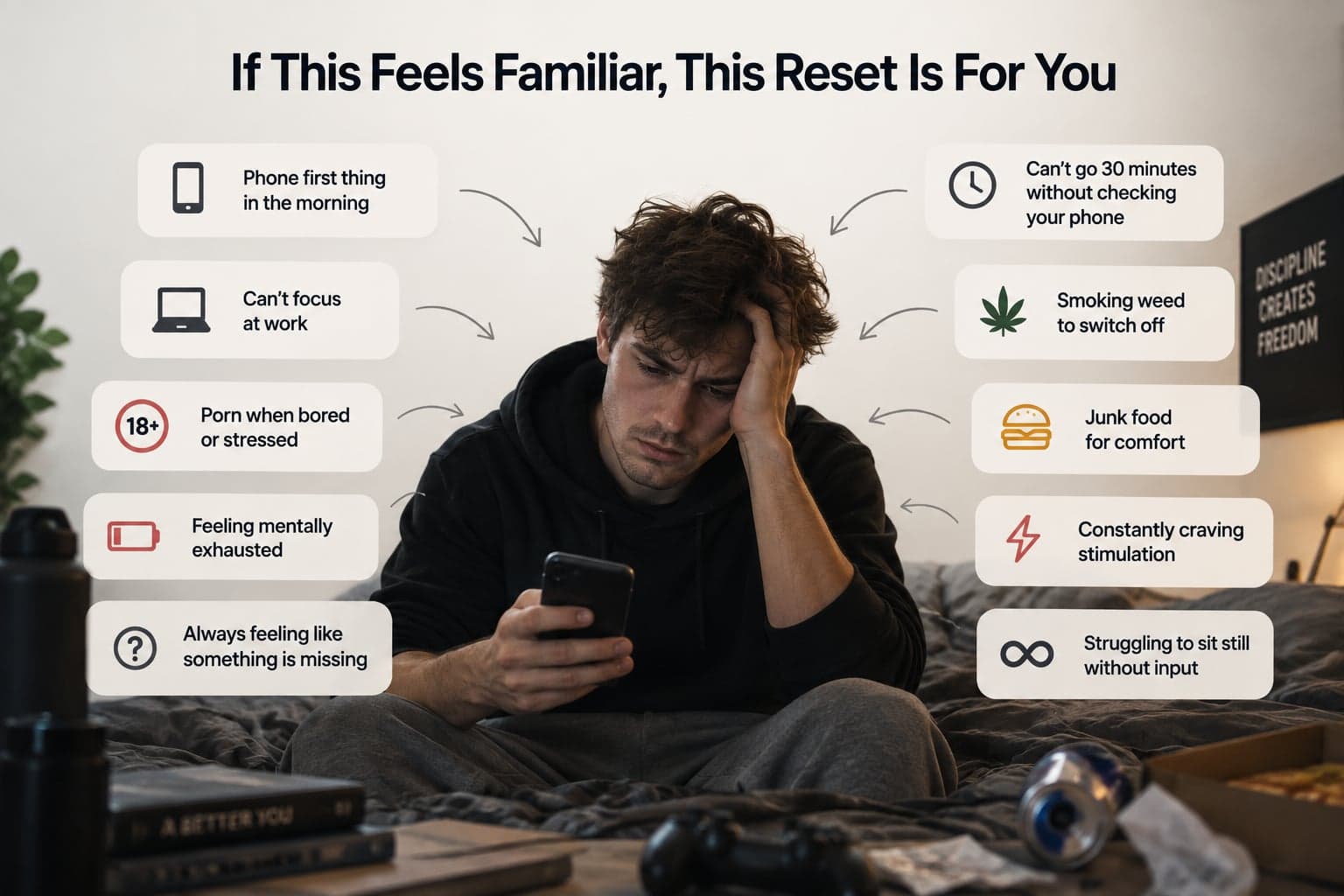
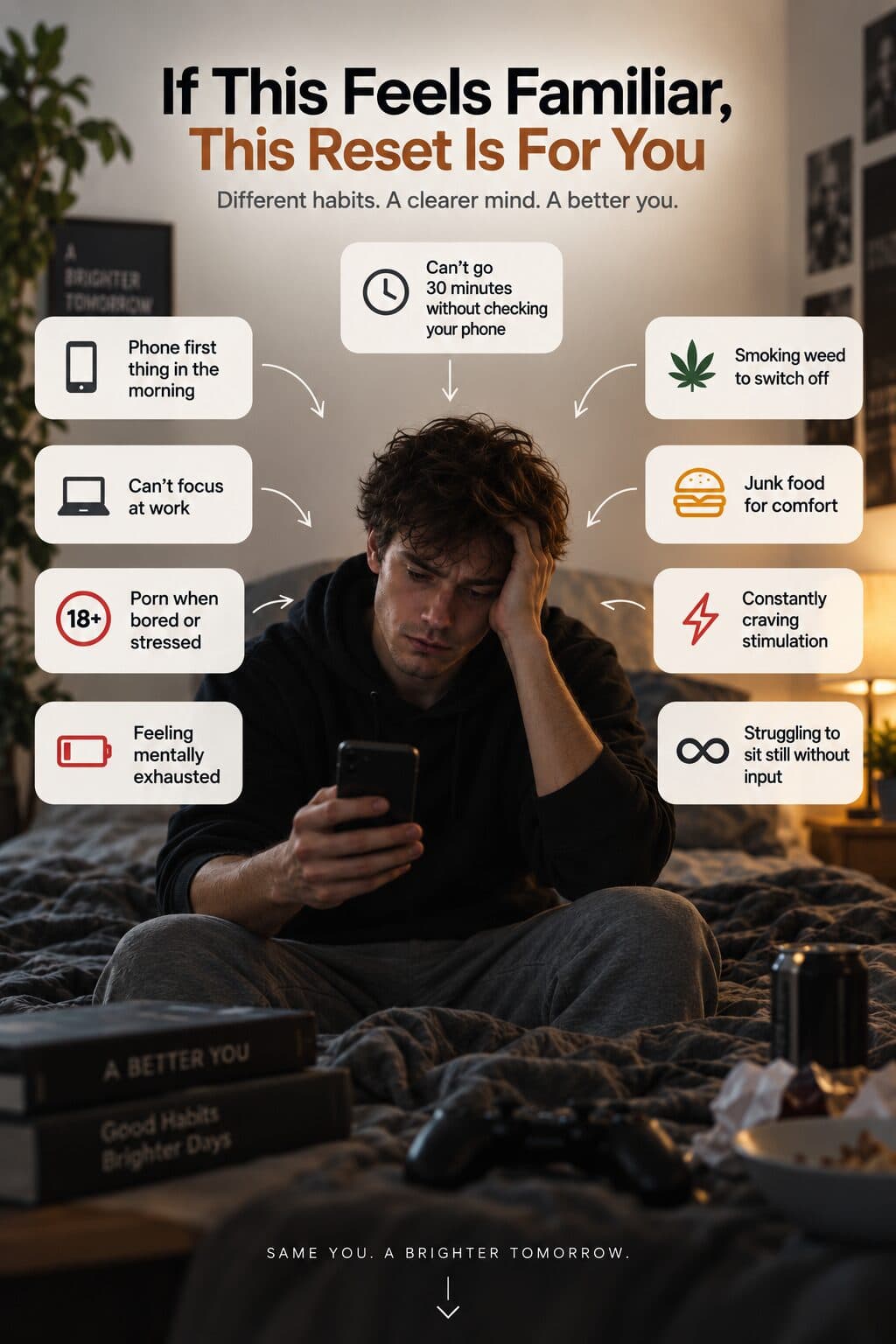
If this feels familiar, this reset is for you
- Phone first thing in the morning
- Can't focus at work
- Porn when bored or stressed
- Mentally exhausted by the afternoon
- A feeling that something is missing
- Can't go thirty minutes without checking
- Reaching for weed to switch off
- Junk food for comfort
- Constantly craving something new
- Can't sit still without input
The feeds, the apps, the whole delivery system got better at holding your attention. You didn't get worse. That mismatch is where the day quietly goes.
The Path
Where you are now, and where day 21 puts you
Where you are now
- Constantly overstimulated
- Scrolling without thinking
- Chasing quick rewards
- Struggling to focus
- Reaching for a screen, porn, weed or junk food when it gets hard
- Running on autopilot most of the day
- Autopilot
- Awareness
- Pause
- Choice
- Intentional
The three weeks
Week 1
Remove the noise
Week 2
Break the loop
Week 3
Take back control
Where day 21 puts you
- You see your triggers coming
- You hold a pause before you act
- You reach for stimulation less
- You focus for longer stretches
- Boredom stops being an emergency
- Your time starts feeling like yours
21 days will not make you a different person. It will stop every urge from making the decision for you.
The 21 Days
Three weeks, one rep at a time
Week 1
Remove the noise
Measure what you actually do for one honest day. No changes yet.
Week 2
Break the loop
Week 3
Take back control
Not Another Detox
You can't detox dopamine. You can retrain the reflex.
- Dopamine isn't a toxin. You can't flush it.
- Your nervous system isn't damaged. It's trained. Trained things can be retrained.
- Every claim in here is checked against primary research, and the fact-check is public.
The Offer
One workbook. One price.
- The full 21-day plan, every day with its actions and its minimum version
- The audit, the trigger system, the focus practice and the replacement habits
- A setback protocol and a 90-day plan for after
$17.99
one time, no subscription
Completion-based guarantee. Work the first fourteen days, keep the dated pages, and if it did not help you get a full refund.
- Instant download
- Yours to keep, and to print
FAQ
Straight answers
You end up more aware, more present and more in control of where your attention goes. You start catching urges before you act on them. You hold focus for longer without reaching for something. You make deliberate choices around scrolling, porn, weed, junk food and the rest, instead of reacting on autopilot. The whole reset is built to move you from automatic to intentional.
This works differently. Instead of leaning on willpower, you work on what sits underneath the behavior: your triggers, your urges, your environment, your replacement habits and how you respond when you slip. You learn to interrupt the loop earlier, so one bad hour stops turning into a lost week.
It's built on behavioral science, habit formation, reward learning, mindfulness, attention training, exercise and environmental design. Every source is named in the appendix and the fact-check is public. The point is to turn that research into daily actions you can actually do, not to hand you theory.
That's one of the main goals. You practice cutting unnecessary stimulation, noticing the pull to switch tasks, removing the usual distractions and holding attention on one thing for longer. The aim is for sustained focus to feel normal again and constant switching to feel like the odd choice.
Most days ask for ten to thirty minutes of deliberate practice. A few, like exercise, reading, a walk or an offline block, take longer by nature. Every day also has a minimum version for when your day falls apart, so it fits around your life instead of replacing it.
No. The phone isn't the enemy, the automatic loop is. Some days ask you to put distance between you and a screen, but the goal is to make stimulation a choice again, not to throw your phone away. A choice you make on purpose counts as a win.
No. It's structured education you work through on your own, and it doesn't diagnose or treat anything. If you're dealing with a mental-health condition, this isn't a substitute for care, so talk to a clinician. The skills can still help alongside real treatment.
It is not a treatment for ADHD and doesn't claim to be, so if that's on the table, talk to your clinician. That said, the attention and design skills here are the kind of external structure many people with ADHD already rely on, so they may still help. Go in with clear eyes.
It's a PDF workbook you download instantly after purchase, built to be written in. You can print the whole thing or just the worksheets and fill them in by hand, or work through it on a tablet. It's yours to keep, with no account to manage.
It is completion-based. Work at least the first fourteen days, keep the dated Stimulation Audit, Trigger Map, and fourteen evening reflections, and email support within twenty-one days of purchase with photos or scans of those pages plus a couple of sentences on what did not work. Do that and it still did not help, and you get every cent back within three business days. Double charges, undelivered files, mistaken purchases before download, and statutory withdrawal rights where they apply are refunded with no conditions. Full policy: /refund.
Safety Note
Educational content, not medical treatment. Don't stop alcohol, benzodiazepine, or opioid use abruptly. Talk to a physician first.
In crisis in the US, call or text 988, or reach the SAMHSA National Helpline at 1-800-662-4357.